Book Cover Design Trends by Genre: What's Selling in 2026
March 27, 2026
Readers take less than a second to decide whether a cover is worth a second look. Not the blurb. Not the author bio. The cover — judged in a glance, mostly unconsciously.
What they're actually doing in that fraction of a second is pattern matching. They've scrolled through thousands of covers in their favorite genre. They know what a romance looks like. They know what a thriller looks like. They know what a literary novel looks like. When your cover sends the wrong signals, they don't stop to investigate — they scroll past.
Genre signaling is the single most important job your cover does. A gorgeous cover in the wrong visual language will tank your sales, even if the book itself is exactly what that reader wants. The inverse is also true: a technically modest cover that speaks fluent genre will consistently outperform a stunning misfire.
Here's what's working on bestseller lists right now, broken down by genre.
Romance
Romance is the highest-earning fiction category on Amazon, and the visual vocabulary is specific and evolving fast.
The palette trend in 2026 is warm — blush pinks, soft golds, sunset oranges, and dusty terracottas. Cool blues and greys have largely retreated to thrillers and sci-fi. If your romance cover has a cold or neutral palette without a deliberate sub-genre reason for it, it's going to read as off-brand.
Typography is doing heavy lifting. Illustrated and script fonts dominate. The "handwritten" aesthetic — loose letterforms that feel pen-written, not typeset — signals intimacy and emotion before a word is read. Clean, geometric sans-serifs (the kind that dominate tech and thriller) feel clinical in this genre and should be avoided unless there's a stylistic reason.
Photography versus illustration is the biggest shift happening right now. Illustrated couples — painterly, slightly idealized, visually lush — are increasingly favored over stock-photo-realistic covers. Illustrated covers are easier to stylize for sub-genre signals and don't carry the "I recognize that stock model" problem.
Sub-genre variations worth knowing:
- Dark romance — Moody lighting, shadowy backgrounds, high contrast. Deep burgundy, charcoal, and obsidian palettes. The couple (if present) is often silhouetted or partially obscured. The cover signals intensity, not softness.
- Cozy romance — Pastel palettes, whimsical illustration styles, often featuring town settings, warm interiors, or seasonal motifs. Lighter typographic treatment. Feels approachable and low-stakes.
- Contemporary romance — Clean and bright. Lifestyle photography sometimes works here. Bolder, more modern typography choices. Less ornate than fantasy-adjacent romance.
A common mistake: designing a romance cover in cool tones because the story involves winter or grief. The palette should match the emotional genre expectation, not the plot weather. Genre mismatch is one of the fastest ways to kill sales — the cover has to speak the genre's language first.
Thriller and Mystery
Thrillers live in the dark. High contrast, deep shadows, and a consistent sense of unease are the genre's visual signature.
The dominant palette is black and dark grey, with deliberate accent colors used for urgency — red being the most common, followed by cold white and isolated pops of yellow. The background is almost never a warm neutral. Warmth signals safety; thrillers don't want readers to feel safe.
Typography is heavy and intentional. Bold sans-serif fonts with tight tracking are standard — often with texture applied (distressed, worn, cracked) to add visual tension. The title treatment on a thriller is frequently the most visually dominant element on the cover, sized larger than you'd expect, sometimes taking up a third or more of the space.
Imagery favors ambiguity and isolation. Silhouettes of figures against lit windows, cityscapes viewed from above, lone figures in empty landscapes, objects that suggest a scene without explaining it. The goal is to create a question in the viewer's mind, not to answer one.
Negative space is used deliberately. A vast, dark background with a small figure or a single object in the center creates visual tension through emptiness. Cluttered thriller covers almost always underperform — the genre signals tension through restraint, not density.
Mystery sub-genres diverge here. Cozy mysteries have their own completely different aesthetic (illustrated storefronts, cats, warm teapot imagery) that borrows more from cozy romance than from thriller. If you're writing cozy mystery, the thriller visual language will actively mislead readers.
Fantasy
Fantasy covers are the most visually rich of any genre — and the most varied. The shared thread is ambition: fantasy covers try to do a lot, and the good ones succeed.
Palette: Jewel tones dominate — deep purple, emerald green, navy, and gold. Black is used as a foundation rather than a primary. Gold or metallic accents are nearly ubiquitous; they signal "epic" and "magical" in a way that's immediately readable.
Typography is ornate. Serifs with display personality — think decorative letterforms, ligatures, medieval-inflected type styles. Borders and decorative elements around the title area are common. The title treatment often integrates with the illustration rather than sitting separately on top.
Illustration is the standard (not photography). Characters and symbolic objects — swords, crystals, celestial maps, mythological creatures — rendered with detail and craft. Epic scale is expected: landscapes with impossible geography, structures that dwarf the characters, magical phenomena that imply a bigger world.
Romantasy — the romance-fantasy hybrid that dominated bestseller lists in 2024-25 and shows no signs of slowing — blends these approaches. It takes fantasy's illustrated style and jewel-tone palette, then adds romance's warmer lighting, softer character rendering, and script typography elements. The result is recognizable as its own sub-genre now, distinct from both pure fantasy and pure romance.
What doesn't work: realistic photography, clean modern typography, or cool-toned minimal palettes. These signal contemporary fiction or sci-fi and will confuse fantasy readers immediately.
Science Fiction
Sci-fi has largely moved toward minimalism — which is counterintuitive given the genre's subject matter, but consistent across the bestseller lists.
Palette: Cool and muted. Blues, teals, greys, and blacks. Neon accents (electric blue, acid green, hot pink) appear selectively, usually in cyberpunk or near-future subgenres. Hard sci-fi and space opera tend toward more restrained color — the vast black of space with isolated points of light.
Typography is clean. Geometric sans-serifs, precise and engineered-feeling. No ornamentation. Letter-spacing can be loose (to suggest technological precision) or condensed (for urgency). The type treatment says: this author is thinking clearly, and so should you.
Imagery favors the abstract or the symbolic over the literal. A single geometric shape against a dark background. A planet seen from a distance. An abstract representation of a concept from the book — a wormhole, a neural interface, a stylized solar system. Character-forward covers exist but are less common than in fantasy or romance.
The sophistication signal here is restraint. A busy, detailed sci-fi cover reads as pulpy; a spare, considered one reads as serious. That's the genre convention, and it's strongly held by the readership.
Literary Fiction
Literary fiction has the most restrained visual language of any major category, and the restraint is the message.
Typography is traditionally serif. Garamond, Baskerville, or similar old-style serif faces at a size that's legible but not shouting. The title and author name are given equal visual weight — in commercial fiction, the title dominates; in literary, the author often gets comparable prominence, especially if they're established.
Palette is muted. Faded photographs, washed-out colors, desaturated tones. Not dark (that's thriller). Not warm and vibrant (that's romance). Quiet. The palette says: this book asks something of you, and you'll find the reward worth the effort.
Imagery tends toward the conceptual and the symbolic. A single object that relates obliquely to the book's themes. An abstract photograph. A piece of fine art. The cover rarely depicts a scene from the book literally — that's considered too commercial. The goal is to intrigue, not to explain.
Whitespace is a design element, not empty space. A small image floating in a sea of white or muted background, with the title set below in a refined serif — this is the cover language of shortlisted prize novels, and readers in the literary fiction space recognize it immediately.
What this genre rejects is just as diagnostic as what it embraces: ornate typography, vivid palettes, illustrated characters, busy backgrounds. If your literary novel has a thriller's high contrast or a fantasy's jewel tones, it will be shelved (mentally) in the wrong category by every reader who sees it.
Applying This to Your Cover
These trends aren't arbitrary. They're the accumulated visual grammar readers have learned from reading thousands of books in their genre. Your cover doesn't need to be original — it needs to be fluent.
If you're using BookClad, the attribute system maps directly to this framework. The Genre, Mood, Art Style, and Color Palette attributes are designed around exactly these distinctions. Selecting "Dark Romance" + "Moody" + "Illustrated" + a warm blush palette already puts you in the right visual territory before you've typed a word of description.
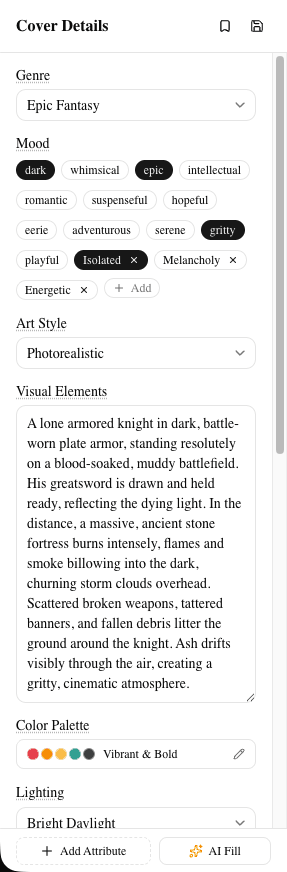
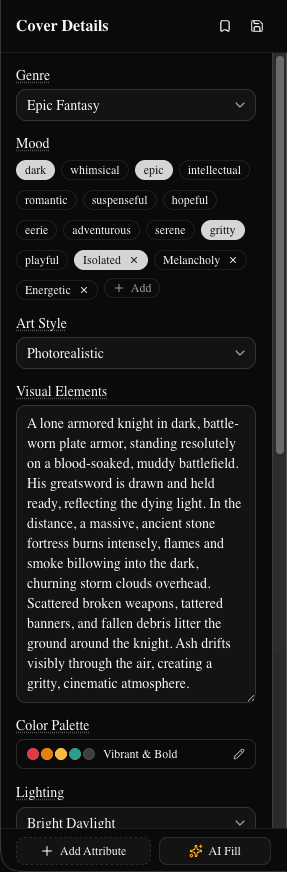
Not sure which combination signals your sub-genre correctly? The AI Fill feature lets you describe your book in plain language ("a cozy mystery set in a small coastal town, amateur sleuth, light and warm") and it suggests the right attribute combination for you. It's a faster way to land on genre-correct settings than manually working through the options.
For typography — once your base cover is generated — the canvas editor lets you add title and author name with full font control. The typography guide for AI covers covers which font styles work for which genres, and how to get KDP-safe text placement.
The core principle: genre signaling isn't a compromise. It's not "dumbing down" your cover or following trends at the expense of your vision. It's speaking the language your target readers already know. Get the genre language right, and everything else — the specific image, the exact colors, the precise typography — becomes refinement rather than correction.
Quick Genre Reference
| Genre | Palette | Typography | Imagery |
|---|---|---|---|
| Romance | Warm — blush, gold, sunset | Script, handwritten, serif | Illustrated couple, soft light |
| Dark Romance | Deep burgundy, charcoal | Moody serif or script | Silhouetted figures, shadows |
| Thriller | Black, dark grey, red accent | Bold sans-serif, distressed | Silhouettes, isolated figures |
| Fantasy | Jewel tones, gold | Ornate serif, decorative | Illustrated characters, epic scenes |
| Romantasy | Warm jewel tones | Fantasy serif + script hybrid | Illustrated couple, magical elements |
| Sci-fi | Cool blues, teal, neon accent | Clean geometric sans-serif | Abstract shapes, space imagery |
| Literary | Muted, washed | Refined serif | Single symbolic image, whitespace |
The table is a starting point, not a rulebook. The best covers in each genre understand the rules well enough to push against them intentionally. But push before you know the rules, and you're just guessing.